


The Substack model is becoming untenable. And, even I, as someone who now publishes (begrudgingly) on Substack, believe a reckoning is coming.
Just one example of the blowback (h/t MW)
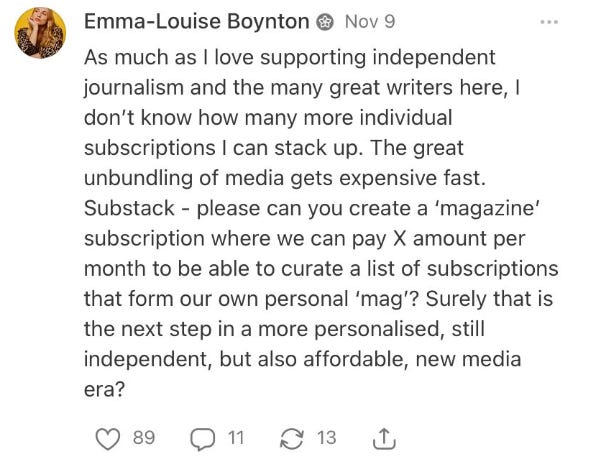
This, sadly, was predictable. It’s why my entire “going independent” plan of 2022 — when I left the FT to found The Blind Spot — was linked to the simultaneous goal of developing a platform to help independents organize. See here. Here. And here.
In case readers think this is a knee-jerk, self-serving piece, I would like to point out that I’ve been thinking about this problem for a very long time, at least since my master’s in journalism in 2001. Out of respect for people’s privacy, I won’t share specific details, but you can read the open letter I shared around the FT in 2015 here.

Having dedicated years of thought to the issue, I’m fairly convinced the challenges are resolvable. But since this is a “systems” issue, it requires politically neutral “systems thinkers” — ideally, those with journalistic experience and belief in independence — to implement the solutions. Not tech bros.
Sadly, there are many reasons why it’s difficult for such journalists to do so. Here are some of the main ones:
Lack of capital. The very real limitations of being a journalist make it hard for me to hustle for funding. If you get investors, you’re not neutral. If you don’t get investors, you have no capital. But if journalists can’t raise funding, only tech bros with no journalism experience build platforms. The inherent problems, therefore, are never solved. Because techbros don’t understand journalism. Or the political economy issue.
Too many sellouts. The only way around problem No. 1 is to grow your business organically until you have the money to spare to invest in yourself. This is easier said than done, however, because many other journalists have no qualms about taking significant sums of money from patrons or investors for their start-up projects. So competition as a neutral operator is tough.
Journalists are not business-savvy. The only way around problem No. 2 is to raise money from a large collective of journalists to build a system that can both scale and protect autonomy, while creating efficiencies for readers. Alternatively, to use that commitment as a letter of interest to then raise money from VCs or investors on more favorable terms. But here comes problem No. 4.
Independent journalists are like cats. Impossible to herd. Those who quit MSM to go independent have no interest in clubbing together and submitting to the whims of other journalists. Too often, they would rather build their own platforms because they all think they can become Bari Weiss. That fiercely competitive and ego-driven streak means they rarely like to collaborate. I know I’ve tried to approach many of them! It doesn’t work. Even if you insist your “solution” is a have-your-cake-and-eat-it system, where independent autonomy is preserved, they still shy away.
Captured. Journalists who understand the system is flawed, but still work in MSM, either fear they don’t have big enough brands or platforms to survive financially outside of the prevailing system, or fear that going independent will compromise their access to sources. They won’t lend their name to a project until it’s already off the ground (in case doing so threatens their day job). Also, it is true that MSM offers them support services and quality controls that independents simply cannot match (unless they collaborate, which they won’t).
Path of least resistance. The current model is deeply entrenched. Nobody in any media corporation has an interest in solving the price/access problem with bundling or collaboration, as they want to retain exclusive control over the revenues they generate. This is a shame, as even at the institutional level, it prevents the emergence of '90s-style cable TV super bundle packages for users.
Brand contamination: When two brands unite and disagree on a critical point, they don’t want to be associated with the other brand’s “wrong” position.
And so here we are. Stuck.
If we can transcend those constraints, I believe, there are three viable options on the table.
A reformed and seigniorage-funded BBC model for the entire English-speaking world. Such an institution would be guarded against political influence by legislative powers. Journalists who operate within it would operate more like public servants than brands or celebrities. Or as I put it on my personal blog in 2014, this would be the makings of a Jedi-like journalistic priesthood.
Timeblock Pay. A simple “interoperability” layer that would allow all users to access signed-up titles at competitively priced short-term access rates. The premise solves the “market for lemons” problem, which otherwise plagues per-article micro payments. It also preserves the value of longer-term subscriptions by applying a “time-value-of-money” dimension to subscription funding. The longer you are prepared to commit to a brand, the greater the discount you get. The system allows for footfall and for brands to charge a convenience premium.
Innscribers. A cross-border platform owned and operated by independent journalists that emulates an Inns of Court structure. Independents retain control of their cash flows while benefiting from scaled-up pooled resources, such as shared legal services, stationery, and access to archives. Critically, such Inns are organized by reputation and shared values, and are guided by a single operating code that they all adhere to. This solves the brand contamination problem and enables subscription bundling or discounted Timeblock access. Users know exactly what standards and biases they are signing up to when they subscribe to a journalist of any particular guild.
The beauty of the third idea is that it is platform-agnostic. While it could provide publishing or escrow services in its own right, it wouldn’t have to. The aim is to allow journalists to join forces according to standards, while giving readers the power to hold them to account by those same standards. There’s more to it than just that, and if you’re interested, see here. Here. And here.
Could Substack integrate any of these ideas directly? Perhaps. “Timeblock Pay” would be the easiest and most obvious feature to add. As an author, I would love to see this functionality.
Currently, I have to direct users to my “£5 for 24 hours access” offer on my still-active WordPress site. It seems silly that Substack doesn’t offer something similar. Prices would ideally be adjusted in hour-block increments, leading up to just a final 1-hour block, or even 15 minutes. So, say, £2.50 to digest all the top stories on any site in an hour (akin to a physical newspaper you would have read on a commute). If you end up consuming the same title every day, you’d just commit to a longer-term, cheaper subscription plan.
But the real opportunity lies in guilds or bundles, along with mutual investment in standard-improving pooled services for authors who share the same editorial values and code. This would in itself improve quality, as authors would gain access to affordable legal services, web development, insurance, office space, podcast studios, proofreading, graphics, and more. They could also apply TimeBlock Pay to a much broader range of coverage, improving reach. Most compellingly, authors would also be able to break free of the infuriatingly templated monoculture of the Substack system, especially in terms of aesthetics.
Bari Weiss, in some ways, did this with the Free Press. But not exactly. Hers was a hierarchical system in which she dictated editorial standards and coverage priority. That’s why her system works in theory, but is difficult to replicate in practice. Journalists are cats. They don’t want to be dictated to, especially if they’ve already acquired some sort of brand.
Under an Inscribers model, the hierarchy would be much flatter, as coverage would be determined by the respective member authors. And that is precisely why it could work.
Bootstrapping this is hard, however, for the reasons already expressed.
I had hoped that Substack might be the obvious party to act as a catalyst. Unfortunately, when I spoke with one of the Substack founders back in 2022, he expressed little interest. It’s not that Substack was anti the idea. They just saw themselves as an infrastructure provider. If journalists wanted to self-organize on their system, they were fine with that, but they wouldn’t be the ones facilitating the process.
In hindsight, this was probably a good thing, as Substack are not neutral operators. They work for the deep-pocketed VCs that funded them.
The need for publicly-funded journalism
I plan to elaborate on the specific seigniorage-funded public media idea outlined above at a later stage. Suffice it to say, I think there’s a huge opportunity to create, or even legislate, a system in which some share of seigniorage profit from the monetary system is transferred away from banks (or stablecoin issuers) and over to a professionally operated, properly ring-fenced, and politically independent journalistic body that serves the whole English-speaking world.
What I want to dwell on at this point, however, is the rationale for a publicly-funded broadcaster of such a variety in the first place. This connects to the history of media in the Western system and the critical role a genuinely independent and apolitical press plays in safeguarding liberal democracy. It is not a history many are aware of. And in light of what’s happening with the BBC, I think it’s worth briefly recounting it.
Before the 1830s, English-language newspapers tended to be expensive, elite-oriented, and openly affiliated with political parties or patrons. This coincided with much narrower democratic models. For example, when America was founded, only white male property owners could vote.
It was only in the 1820s, with the invention of cheap printing methods and the rise of the so-called “penny press”, that States began gradually eliminating property requirements for voting.
The rationale for the original property-based voting condition wasn’t linked to an unhinged or elitist contempt for the poor, however. It was more that the Founding Fathers believed that only property-owning men had enough independence, education, and enough of a “stake in society” to make responsible political decisions. They feared that broad suffrage would empower unstable populist forces or factions. It was, essentially, a belief in honorable paternalism.
That paternalistic control over the system, however, came under challenge as cheap publications began flooding it, elevating working-class perspectives and interests.
The result was a competitive environment where vivid crime reporting, sensational stories, and emotional human-interest narratives — exemplified by the Sun’s 1835 “Moon Hoax” — became central features of the press economy.
The consequences were profound, especially in terms of political campaigning.
Many of the practices we take for granted today, from sensationalist rhetoric to publicity-seeking events and emotional appeal to voters, owe their origins to the rise of the penny press.
America’s first truly populist president, Andrew Jackson, the founder of Jacksonian democracy, and the man who tore down the Second Bank of the United States, was also a product of that landscape.
Donald Trump’s savvy use of Twitter Jackson’s to build his political base is today often compared to Jackson’s cunning use of the penny press to define his image and woo voters. Jackson also, incidentally, had a tendency to describe opposition press as “peddlers of calumny” and “slanderers”.
But while the penny press began as an anti-elite, anti-corruption force, over time, its business model made it vulnerable to exploitation.
Earlier partisan newspapers, for all their flaws, frequently published long and thoughtful editorials on political theory, party platforms, and arguments aimed at educated readers.
With the penny press, on the other hand, political debate was too often reduced to “read all about it” headlines or party political slogans, giving rise to new forms of populism, media manipulation, and political dysfunction.
As understanding of this new form of public manipulation grew, a new segment of readers and advertisers (including the newly literate) began seeking out more trustworthy, less inflammatory journalism.
The result was a new breed of “quality press” distinguished by systematic reporting, editorial consistency, and an explicit rejection of penny-press sensationalism. Horace Greeley’s New York Tribune (founded 1841), for example, offered a reformist, serious tone, while Henry Raymond’s New York Times (founded 1851) was explicitly marketed as an antidote to the noise and emotionalism of cheap papers.
Paul Starr, in The Creation of the Media, has argued that these newspapers institutionalized professional norms — verification, editorial hierarchy, foreign correspondence — that would define modern journalism.
This, self-evidently, is the phase we are replicating now. Sensationalist content and click harvesting are giving way to more thoughtful, quality-focused, and long-form journalism, exemplified by the rise of Substack and the broader podcasting phenomenon.
Even so, neither independent Substackers nor podcasters have the scale or quality controls to substitute for the old-guard “quality media” yet.
Moreover, if they did, we would soon face a new problem.
Historians of the press generally agree that although the emergence of the “quality press” in the mid- to late-nineteenth century improved reporting standards, it also reintroduced economic and class barriers to news access that the penny press had briefly broken down.
Normies couldn’t afford the New York Times. And there was, for a long time, no compensating public service akin to the BBC's.
As Michael Schudson, in Discovering the News, puts it, the penny press had created a “mass democratic” readership, but the serious press that followed increasingly spoke to a “commercially literate, respectable public.”
What evolved, as a result, was a dual media system: a sober, fact-centered press directed at professionals and merchants, and a cheaper, more sensational tabloid press aimed at workers and the poor. Such a landscape held sway until the advent of the internet in the 2000s changed everything.
Elites can argue until the end of days about whether the Internet — particularly social media — has since then been a net good or a net harm to society.
Since 2016, the dominant establishment narrative has famously held that the new media structure proves that “the people are stupid” and must be protected from their own gullibility. Indeed, without broader protections, the narrative suggests voters will choose self-sabotaging policies such as Brexit or elevate crude, opportunistic populists like Donald Trump. It is this line of reasoning that now underpins many “online safety” initiatives and anti-disinformation measures.
On the other side is the popular view that elites stopped serving the public’s interests long ago because they became too insulated in their ivory towers. As they became preoccupied with luxury beliefs or absorbed by globalised interests, ordinary citizens were left behind. The internet, in this narrative, helped realign the system by highlighting the elite's failure to uphold their public duty.
Whoever is right or wrong, one thing is clear.
If we are to maintain a liberal democratic media structure, we don’t really need chat control or disinformation shields. What we need are safeguards to ensure elites cannot be as easily captured by hostile or foreign interests or as separated from genuine public opinion as they became in the noughties and 2010s. Likewise, if democracy is to remain as inclusive as it is today, we need mechanisms that ensure both the time-poor and those caught up in self-referential bubbles are exposed to the full spectrum of public opinion.
And that is why, in the midst of a great rebundling that is carving out our future intelligentsia — and which will inevitably tilt towards partisan views and increasingly inward discourse — we must also strive to create a new neutral media for the common good. Ideally, one that is publicly funded and structurally insulated from political or commercial capture.
The problem, as ever, is how to fund such a body in a democracy and a free market without inviting political influence.
Using seigniorage proceeds, especially those derived from non-bank stablecoin issuers associated with social media platforms, could offer a practically invisible and fairly distributed means to raise funds to counter bubble thinking.
The resulting institution would then serve as a public conscience to guard against systemic cognitive hacking — grounded in statutory independence and kept honest through radical transparency, reader scrutiny, and continuous public feedback.
This logic becomes even clearer when we look back to the origins of mass communication. The postal system was funded not by charging every recipient, but by levying small fees on the operators of the communications network — the service that moved messages. In the digital age, the closest equivalent is the major online platforms, especially those seeking to issue their own monetary stablecoins and thereby gain quasi-sovereign influence over communication and commerce.
The BBC analog
It’s worth remembering that when the BBC was formed in 1922, the government explicitly ruled that even though it was originally forged as a private company by a consortium of radio-manufacturing firms (the techbros of the day), it should be prevented from controlling the airwaves as a profit-seeking monopoly, since airwaves were a public resource.