

Why modern financial architecture struggles to detect counterfeit institutions
Ottoman bazaars and open-outcry trading pits relied on witnessed verification to engender trust. GameStop’s bid for eBay may be exposing just how thoroughly modern finance abandoned those principles.

This is a guest post by Erhan Civelek, a former strategy consultant at Bain, BCG, and Kearney, and the grandson of a fifth-generation Grand Bazaar merchant. He is completing a book of the same name and writes The Counterfeit Scale, a Substack on fraud, institutional design, and the structural conditions that make deception rational.
As GameStop CEO Ryan Cohen highlights the value creation opportunity in resolving eBay’s verification deficit, Civelek argues that modern finance abandoned older forms of witnessed verification at its peril. From Istanbul’s Grand Bazaar to open-outcry trading pits, he contends that markets once relied on architectures that made deception structurally harder — and that their disappearance helped create the conditions for today’s “Counterfeit Institutions”.
On my desk sit two objects.
One is a 19th-century Ottoman merchant’s brass scale. My grandmother Sevgi weighed spices on it in Istanbul’s Grand Bazaar for customers who returned year after year because they knew the weight would be true.
The other is a printout: an investment account statement showing consistent returns of 11-13 percent, quarter after quarter, from a vehicle that never invested a single lira — built by a man who had studied what genuine accountability looks like and counterfeited it precisely.
They are there to remind me of two age-old financial practices designed to counter each other.
The scale signifies a verification mechanism.
The statement signifies what I call a ‘Counterfeit Institution’.
A Counterfeit Institution is, in my eyes, any organisation that has successfully decoupled the performance of accountability from its actual exercise.
I spent 25 years as a strategy consultant at Bain, BCG, and Kearney, advising institutions on how to appear investable, scalable, and credibly governed. I was, in effect, a professional producer of the signals required to make an organisation appear accountable. My grandmother, on the other hand, resorted to something entirely different.
The collision between those two perspectives is where the framework I use to view finance was born.
What a ‘Counterfeit Institution’ actually is
FTX had a regulated audit relationship. Theranos had board members from the Hoover Institution and the US military. Wirecard had a Big Four auditor for years before investigative reporting — including the FT’s own — exposed what the numbers concealed.
In each case, the institution did not avoid oversight. On the contrary, it satisfied the rudimentary requirements of appearing to have oversight, which is an entirely different thing.
The standard post-mortem in cases like these tends to focus on what failed inside the watchdog system itself. I contend, however, that the problem runs structurally deeper.
The question is not merely why the watchdogs failed.
It is why modern institutional architecture has made it so easy to satisfy accountability without meaningfully exercising it.
The answer lies in a substitution that took place so gradually we barely noticed it.
Slowly, over time, the world replaced witnessed verification, such as that historically provided to gold reserves by European burgomasters, with documented verification. We called this extension of the line of sight progress.
In many ways, it was. But it also injected the system with entirely new vulnerabilities.
What the Grand Bazaar instinctively knew

This is where the practices found within Istanbul’s Grand Bazaar are instructive. The marketplace has operated continuously for 564 years, surviving the fall of an empire, two world wars, hyperinflation, and a number of military coups, all without any need to make do of written contracts between buyers and sellers, a financial regulator, or a compliance department.
This was no fluke of fate. The secret to its consistency lay in its trust architecture, which made the rise of a Counterfeit Institution within its system structurally irrational rather than merely illegal.
Three mechanisms made this possible.
First: spatial transparency.
The Bazaar consists of 67 streets, each historically occupied by a single guild trade. Every competitor is visible to every other. Fraud has no privacy in which to operate because the corridor itself acts as the regulator.
Second: the muhtasib.
The muhtasib was an Ottoman market inspector appointed by the sultan and answerable to the qadi — an Islamic judge responsible for commercial and civic disputes. Unlike conventional supervisors, he was paid from fines rather than by the merchants he supervised, so his incentives were structurally aligned with identifying fraud.
The other key to his effectiveness is that, unlike routine supervision cycles, he had the right to demand inspections unannounced.
These inspections consisted of the muhtasib using his own standardised weights to test the accuracy of those in use in each stall.
Crucially, his independence was not merely procedurally required — it was structurally guaranteed through the way he was appointed.
Moreover, the unannounced nature of his arrival was no trivial detail. It was central to the trust architecture underpinning the entire flow of trade.
A scheduled inspection tells a dishonest firm which numbers to make convincing and which weights to swap back before the inspector arrives.
An unannounced inspection makes preparation impossible — which means the deterrent operates continuously rather than periodically.
The threat was not “he will come”, as is too often the case today. It was “he could come at any moment”.
That distinction is the difference between a compliance exercise and an accountability system.
Unfortunately, the muhtasib system — even in the Grand Bazaar — was abolished in 1849 and replaced by provincial councils with more complex relationships to commercial interests.
What arrived in its place was scheduled oversight.
The Counterfeit Institution became structurally possible the moment inspection acquired a calendar.
A natural objection at this point to the idea that these problems still persist is the rise of blockchain. If every transaction is recorded on an immutable distributed ledger, after all, does it not solve the verification problem?
Sadly, it does not — and the reason is architectural. Blockchain may be an extraordinarily reliable mechanism for verifying that what was recorded was recorded accurately, but it cannot verify that what was recorded was true at the point of origination. A false weight placed on an honest scale still produces a false reading — permanently and immutably recorded. The muhtasib’s job was not to audit the ledger. It was to test the weight before it touched the scale. That function has no blockchain equivalent. It requires an observer with skin in the game, arriving unannounced, with their own standardised measure.
Luckily, in the case of the Grand Bazaar, it was buffered by the following key element.
Dynastic reputation.
Guild membership passed from father to son. The temporal horizon of accountability was not quarterly — it was a lifetime, compounded across generations.
The Counterfeit Institution cannot survive this kind of time horizon, since the economics of fraud require an exit and a payout before the consequences are felt.
None of the above represented trust signals.
They were trust verification mechanisms.
That distinction is the entire argument.
What the trading pit knew
Open outcry is usually remembered as theatre — men in coloured jackets shouting, gesticulating, apparently in chaos.
But the ritual represented more than fanciful optics.
It was one of the most sophisticated real-time systems of witnessed verification financial markets have ever produced.
Yes, it was performative.
But that was precisely the value point.
When a trader waved his arms and jumped to unwind a large short position, he was making his intention legible to every participant in the pit simultaneously.
His urgency was readable in his body. His fear was audible in his voice.
Economists Coval and Shumway have demonstrated that ambient sound levels in trading pits could predict volatility. The noise itself was information.
The hand signals, too, functioned as a verification protocol.
Palms inward: buying. Palms out: selling. Fingers to specific parts of the face indicating quantity in standardised increments.
Mastery of this language was a credential that could not be faked by someone who had not spent years in the pit. The body was both the signal and the proof of authenticity.
When the CME closed its open-outcry pits in 2015, it ended 167 years of price discovery based on mutual verification.
What was lost was not just efficiency.
It was the performance dimension of verification — the embodied, public act of transacting in a space where everyone could see what you were doing.
The structural parallel with the Grand Bazaar is exact.
The guild street concentrated competitors in a single visible space where deception was expensive. The trading pit concentrated traders in a single visible space where manipulation was visible.
Both were replaced by systems that were faster, cheaper, and more scalable — but also architecturally more hospitable to the substitution of performance for function.
A good illustration of what has been lost can be seen in the way markets now struggle to process ambiguity generated by performative political statements.
A key episode came a couple of weeks ago, when President Trump posted thirteen times in one hour that Iran had agreed to open the Strait of Hormuz permanently, hand over its enriched uranium, and end its nuclear programme.
Oil fell sharply. Markets rallied.
Iran’s negotiators denied every claim.
None of the stated agreements existed.
It was later discovered that a $760 million short position on oil had been placed twenty minutes before Trump’s first post.
Through the lens of my framework, the presidential statement performed the function of a verified geopolitical agreement without actually being one.
Markets moved because the performative signal was indistinguishable from a genuine signal.
The problem is that no existing verification mechanism can operate at the speed of algorithmic trading.
Yet in the days of trading pits, the foreknowledge embedded in that $760 million short would have been partially visible — in positioning, in noise, in the bodies of traders who knew.
On a screen, it appeared merely as a number that flashed briefly and disappeared.
Suffice it to say, counterfeit institutions thrive in precisely these gaps between signal and verification.
Wirecard, FTX, Theranos, and the Strait of Hormuz merely represent different scales and domains of the same structural problem: the performance of accountability without its exercise; the signal without the substance it was meant to verify.
Financial cheap fakes
Today, we are living through what might be called the cheap fake era — a moment in which the cost of producing convincing institutional signals has collapsed, while the mechanisms for verifying them have been progressively dismantled.
AI accelerates the final step.
But the conditions were established long before: the moment we decided that a scheduled audit was equivalent to an unannounced inspection, that a board resolution was equivalent to a guild warden walking the corridor, that a documented agreement was equivalent to a witnessed one.
The question this framework is designed to force is not “how do we build better documents?” Documents can always be counterfeited.
The true question that needs to be asked is: what is the modern equivalent of the muhtasib?
What does witnessed verification look like in a market that has been deliberately designed to run without it?
The Grand Bazaar and the trading pit are not nostalgia.
They were systems in which trust remained physically and socially legible.
The brass scale on my desk is honest because it cannot lie. The physics of balance make deception immediately visible to everyone present.
Unfortunately, modern financial architecture has spent a century perfecting the statement of truth and forgetting the scale.
The cost of that forgetting is visible in the ruins of institutions that satisfied every oversight requirement while exercising none of them — and in a $760 million oil position placed twenty minutes before a geopolitical announcement that turned out to be fiction.
We did not lose our ability to verify. We built systems in which verification became optional.
A GameStop after thought
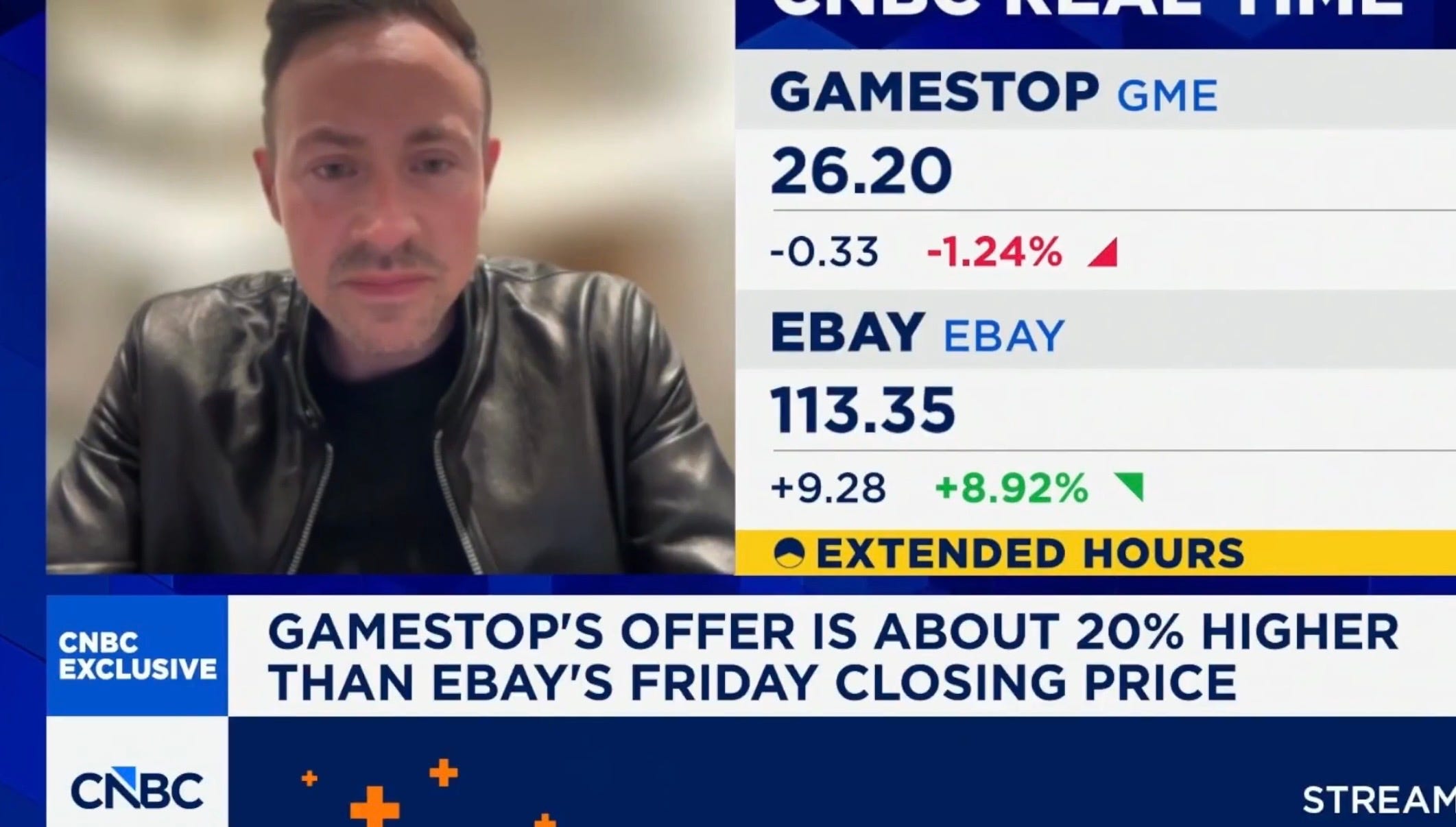
Since this piece was first drafted, two developments have made its central argument more topical than anticipated.
First, GameStop — the meme stock retailer that became a cultural phenomenon in 2021 when retail investors staged a historic short squeeze against institutional sellers — has announced an unsolicited $55.5 billion bid to acquire eBay, the online marketplace, at $125 per share in a deal comprising 50 percent cash and 50 percent GameStop stock.
Wall Street analysts have been left largely baffled. GameStop, worth roughly $12 billion, is proposing to acquire a company nearly four times its size. The financing relies on $9.4 billion of cash on its balance sheet and a $20 billion highly-confident letter from TD Securities — a structure that has drawn considerable scepticism.
But buried in Ryan Cohen’s offer letter to eBay’s board is a sentence that reads, through the lens of this piece, as something close to a thesis statement: “GameStop’s ~1,600 US locations give eBay a national network for authentication, intake, fulfillment, and live commerce.”
Authentication. In a $55.5 billion deal memo.
Cohen’s argument — stripped of the financial engineering — is that physical verification infrastructure is worth billions of dollars as an addition to a purely digital marketplace. That eBay’s problem is not its scale, its brand, or its cost base. It is that it has no muhtasib. No human observer who arrives, unannounced, and tests whether what is being sold is what it claims to be.
Whether or not the deal succeeds, that insight is the correct one. And it suggests that Ryan Cohen may have understood something about the value of witnessed verification that the analysts scratching their heads have not yet grasped.
Second, GameStop has simultaneously announced its intention to conduct a float count — requiring shareholders to provide proof of ownership through legal proxy and valid identification — to test whether the shares circulating in the market actually exist. If more shares are found outstanding than were ever issued, institutions could be held liable.
This, too, is a muhtasib moment. An unannounced inspection. Standardised weights. The entire system tested against reality rather than documentation.
The Grand Bazaar would have recognised both moves instantly.
I liked the article and subscribe to its basic premise. I would add the City of London and its motto "My Word is My Bond" when it was confined within the Square Mile and transactions were physical but particularly within segments such as the money market. This was dismissed in the 1980s as an Old Boys' Club.
But it wasn't perfect. Humanity is just too inventive. And it extracted rents from everyone else.
I therefore doubt the Grand Bazaar was as competitive as suggested. And as for the futures pits, remember that the FBI broke up a ring of traders who used foot signals, among other devices, to rig deals!
But this is a question of degree. And those markets were explicitly based on honour and trust. People transgressed but transgressions were clearly seen as a breach of the rules.